How to Dynamically Scale Font Size in Godot [Clean Approach]
![How to Dynamically Scale Font Size in Godot [Clean Approach]](/content/images/size/w1200/format/jpg/2025/08/febucci-automatic-font-scaling.png)
Godot 4 doesn't auto-scale font sizes when your UI controls resize, which means text can look wrong at different resolutions. We ran into this while working on our game and wrote a simple GDScript solution that adjusts font sizes through theme overrides at runtime, no pixelation, no hacks. This tutorial covers the full approach for both Label and RichTextLabel nodes.
How do I dynamically change font size in Godot?
In the difficult quest of making games compatible with (almost) all the existing screen resolutions, one of the main problem we've encountered is how to scale texts properly when resizing the UI.
In Godot (at least up to version 4.4) text size is not automatically scaled if its control scale changes (e.g. Label, RichTextLabel, etc...), so we need some tricks to get around this problem. If you're new to Godot UI in general, check out our Godot UI tutorial first for the core concepts.
Our goal target
We're not thinking about resizing the windows!
"Font scaler" script
We need to create a script that automatically scales the font of a target text node (e.g. Label, RichTextLabel, etc...). The full solution for a Label node comes in at around 25 lines of GDScript, and the RichTextLabel version (which handles 5 separate font size themes) adds about 15 more.
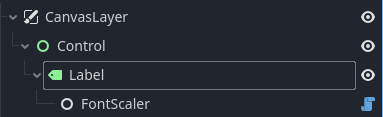
Initial state
We are scaling the font/text based on the initial state of our label, which means that we need to cache everything from our target text first. This includes the initial font size and the control size itself (so that we can make a linear proportion).
var base_font_size : int
var base_size : Vector2
var label : Label

func _enter_tree():
  # caches initial sizes
  label = get_parent() as Label
  base_size = label.size
  base_font_size = label.get_theme_font_size("font_size", label.get_class())
GDScript snippet to initialize the base size
Updating the font when the control changes
Every time the control is scaled we need to compare the new size with the base one, calculate the scaling ratio, and update the font size. There is also a hard cap at 4096 pixels for bitmap fonts, so we need to guard against that too.
- Listen to the
resizedsignal in_enter_tree() - Disconnect from it in
_exit_tree() - In the handler, compute
scale = new_size.x / base_size.x - Multiply
base_font_size * scale, clamp to 4096, then calladd_theme_font_size_override
First we need to listen to whenever the control is resized. We're using the resized signal here, and if you want to go deeper on how signals work in Godot, we wrote a full post on Godot signals architecture.
func _enter_tree():
  # ...

  label.resized.connect(set_text_size)

  # ...

func _exit_tree():
  # remember to disconnect when exiting!
  label.resized.disconnect(set_text_size)
Then, the actual method that applies the scale:
func set_text_size():
	var new_size = label.size

	# scale base on control width
	var scale = new_size.x / base_size.x
	var scaled_size :int= floor(base_font_size * scale)

	# bitmap cannot be greater than 4096
	if scaled_size>4096:
		return

	# apply scale
	label.add_theme_font_size_override("font_size", scaled_size)
Now the Label text should automatically scale when the text control changes size. Yay!
Modifying the code for RichTextLabels
RichTextLabels are a bit more complex, because they have multiple font sizes inside their theme (for the "normal" font, italic, bold etc.). Specifically, RichTextLabel exposes 5 font size theme overrides: normal_font_size, bold_font_size, italics_font_size, bold_italics_font_size, and mono_font_size.
The rest of this post is available for free!
Please create an account to continue reading! It helps us knowing that humans are reading us, and also helps us staying independent and keep posting what we love. Thanks!
Create a Free Account & Continue Reading


