A Behind the Scenes chat with Happy Broccoli Games about Duck Detective


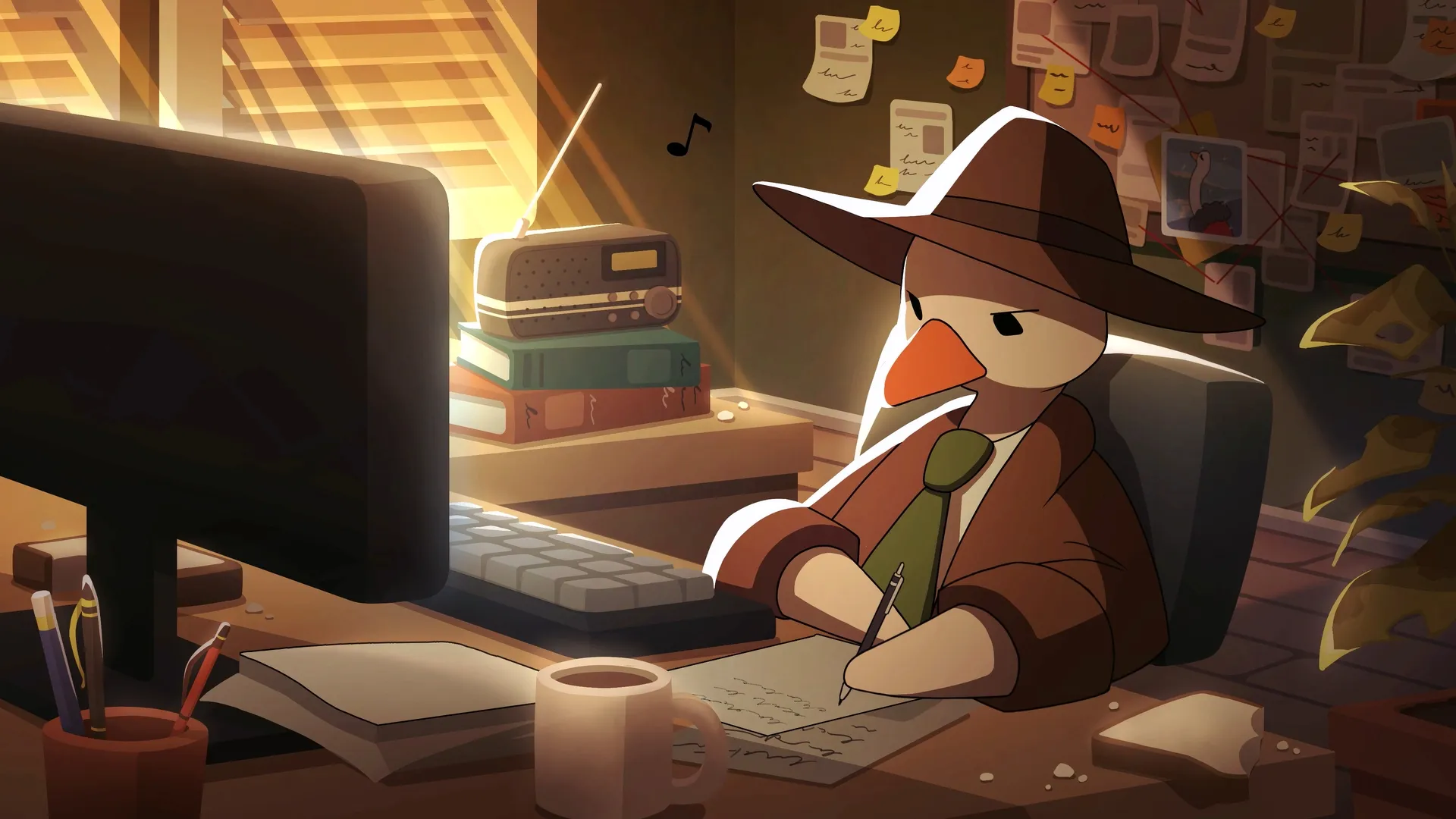
Today I had the pleasure to interview Joni Levinkind, Programmer and Game Designer at Happy Broccoli Games, a small Berlin-based indie studio. The team created Duck Detective: The Secret Salami (2024) and Duck Detective: The Ghost of Glamping (2025), and they used Text Animator for Unity in a way that really bring to life the emotion in the dialogues!
In both games, players step into the webbed feet of a duck detective, solving crimes and mysteries with the power of de-duck-tion (as the team at Happy Broccoli Games likes to call it!) The games blend 2D and 3D visuals, take around two to three hours to complete, and have been a great success, selling approximately 230,000 copies and receiving plenty of positive reviews.
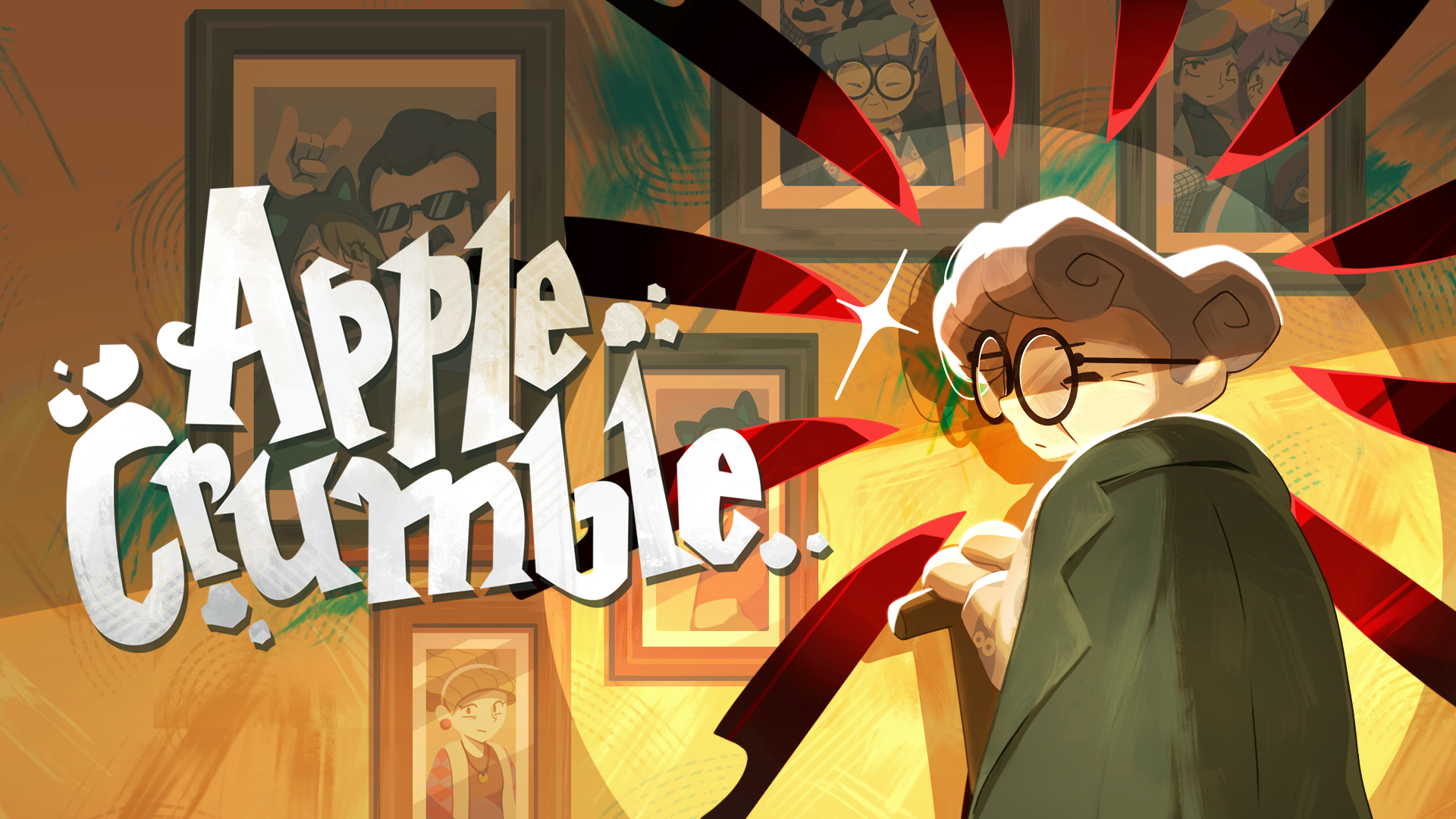
The team is now working on a new game called Apple Crumble, recently seen in the Day of the Devs during Summer Game Fest and is currently planned for release later this year (and we are also gonna see Text Animator in this game!).
We had a wonderful conversation about game production, the challenges of running a small team in the industry, and the experiences the studio has gathered along the way. I hope the interview will be useful and inspiring for all the game developers reading!
The interview with Happy Broccoli Games
Febucci Team: Hi, thank you and we are very happy that you decided to take part. Let’s start with a simple question: could you tell us who you are, how Happy Broccoli Games came to be, and what your team structure looks like today?
Joni:
Hi there, I am Joni. I handle most of the technical work and decisions at Happy Broccoli Games. Annika founded the company back in 2019 and is our creative director, juggling art, design, writing, and so many more other things. Our third team member is Caro. She handles concept art, and also more. As a small team, there’s always plenty of other tasks to do from accountancy, sales management, coming up with duck puns, or answering interview questions. It’s hard to put labels on it all!
We also have ~3.5 freelancers for music, sound design, tech art, etc. We’re also working with Airborn Studios, an amazing art team, on our newest title, Apple Crumble. There’s even more people I could mention who help make our experiences become a reality. It takes a whole host of talented people to create a game, from localization, porting, trailer making, and that’s not even taking into account the people working on the game engine, or folks such as yourselves making great plugins/tools to speed up our development.
The Secret Salami, scope, and sustainability
Febucci: How did the idea for Duck Detective: The Secret Salami come about? We’re especially interested in the creative and production process: where did you start from, how did you define the scope, and what decisions allowed you to turn the idea into a publishable game?
Joni:
The game was conceived on a train ride from Cologne to Berlin. We’d had a fairly unsuccessful Gamescom, and were left with ~6 months of runway before we’d have to close the studio. We decided to pivot from our larger project which couldn’t be finished in that time, and make a final ditch effort to finish something small with our remaining resources.
Annika had been considering a detective game for a few years in her mind. She’s a big reader of Agatha Christie novels, and she was confident the fill-in-the-blanks style gameplay that had been popularised by Obra Dinn, and then simplified by Golden Idol, could be further simplified for a more approachable and light-hearted experience. And I just really like ducks.
Annika still has a notebook from that train ride, and honestly, about 80% of the final game is completely accurate to those initial designs. I think being so constrained forces you to focus quickly. For us, art is always the bottleneck, so we immediately agreed there would be zero animation in the game. That constraint helped lead us to the stickerbook style 2D characters in the 3D isometric world.
Truthfully, it’s quite hard to recall what it was like at the time to make the game because with hindsight the experience is reframed. We really didn’t believe it would resonate with people as much as it has.
I just remember it being fun and flowing well. Because we’d spent the last 18 months building the team & communication for the larger project - it felt like everything was in place and there wasn’t any sort of pre-production. It was so easy to re-use systems (as well as design elements) even though the other project had nothing to do with detective mysteries. I strongly believe that nothing is ever wasted when it comes to creativity. Not all projects will see the light of day, but they can help germinate your future works.
Febucci: Was keeping the scope small something you had in mind from the very beginning? Or did it change during development?
Joni:
With the initial plans for the game, we thought it would only be 20 minutes long, and it ended up ~2 hours, and that was after cutting out some content, so I think it can be healthy to plan something small and then let the project grow to its natural size.
Duck Detective Gameplay
Febucci: How much actual time did it take to develop The Secret Salami, and how did you divide that time between development and other related activities, such as QA, marketing, outreach, and porting?
Joni:
From inception to release it was 9 months. We say ~6 months for development and then 3 months for marketing at the end, but honestly, promotion is a constant task throughout development, especially with announcements and events being threaded within the development schedule.
Producing two games close together
Febucci: The second game, The Ghost of Glamping, came out after only one year. Was it already part of your plan from the beginning to release it so soon?
Joni:
Ghost of Glamping actually took us longer to make than Secret Salami. I think one thing I hadn’t realised was the sheer amount of additional admin and operational tasks when a game does well (and you self-published it). It’s a nice problem to have, just one we hadn’t factored into our schedules.
Over the summer of 2024 it became clear to us that we wanted to follow the exact same marketing cycle, as if something isn’t broken, then best not to alter it! So the second game was released 1 day before the first’s anniversary.
Febucci: Which parts of the first game were you able to reuse efficiently, for example pipelines, tools, narrative structure, UI, assets, or code, and which parts did you decide to rethink from scratch for the second chapter?
Joni:
The second game is effectively in the same Unity project as the first. We tried a few different set ups, but found this was a simple way to ensure any improvements and bug fixes could be easily back-ported to Secret Salami. There’s always pros and cons to architecture decisions, so it’s by no means a perfect solution. But it was nice to have everything already in place, and most improvements and fixes have ended up in Secret Salami over the course of patches.
Febucci: Is there anything that, after the first Duck Detective, you explicitly decided not to do the same way in the sequel?
Joni:
We knew from the beginning we would change how the hint system worked. We weren’t happy with the system in Secret Salami, but there was no time to change it before release.
It had a number of issues that stemmed from it being an internal monologue the Duck Detective has with himself. We already had a better system in mind when we were spinning up the Ghost of Glamping, and we’re happy with the results.
It’s difficult designing hint systems for a puzzle game because from what we’ve seen in playtesting some people really want to solve things without any assistance, even though they might have much more fun when the system gives them that little nudge in the right direction.
It’s something I’ve had to come to peace with; if we explicitly label the system as hints some people will immediately ignore it.
Duck Detective Gameplay
Self-publishing, marketing, and platforms
Febucci: Duck Detective was also released on Xbox and Switch. How did you fit console porting into the production timeline? What were the main complications, and what would you recommend to a small team that wants to release on multiple platforms?
Joni:
One of the big challenges with production is trying to chart a successful voyage with incomplete information. There were a few reasons why there was little uncertainty with console porting Duck Detective:
- We work with a fantastic freelance programmer, Daniel Collier, who handles the porting
- We had experience with console platforms with our first title
- The game itself is technically simple. Fixed camera, low-poly art, singleplayer etc.
There was fun and there was pain learning how to do porting, but I would do it again because it’s very cool seeing your game on some big storefront for the first time! If I had to learn again from the beginning, I think the most important lesson is to take time learning how to release on each platform.
Ghost of Glamping released on Steam, GOG, Switch, Xbox and PS5 on launch day. But the only way that happened was by building up the knowledge from previous titles. It would’ve been a near impossible task with no experience.
There’s no need to sim-ship either. You can always postpone console releases until after the game is released and stable on PC, as updating across 5+ platforms is laborious.
So ultimately, if a small team is looking to tackle multiple platforms, I would recommend learning each platform individually over time, possibly with multiple releases, rather than planning a multi-sim-ship release for a debut title.
Text Animators for all of Happy Broccoli Games’ titles
Duck Detective Gameplay
Febucci: When did you decide to include Text Animator in the Duck Detective games, and why? Was it the first time you used it, or had you already used it before?
Joni:
We’ve used Text Animator for all of Happy Broccoli Games’ titles. We integrated into Kraken Academy!! during development back in 2020. The moment I saw it on the Unity asset store I just had this feeling it was going to be a perfect solution, and it really is fantastic and easy to use.
Febucci: Who on your team decided which words should be animated? After that, did that person implement them directly, or were they passed on to a programmer?
Joni:
Annika writes them directly in the dialogue using the rich text tags, so it’s nice and simple for her.
We use a custom dialogue system which effectively uses text files with custom formatting so it can be written with any tool the writer (Annika) decides.
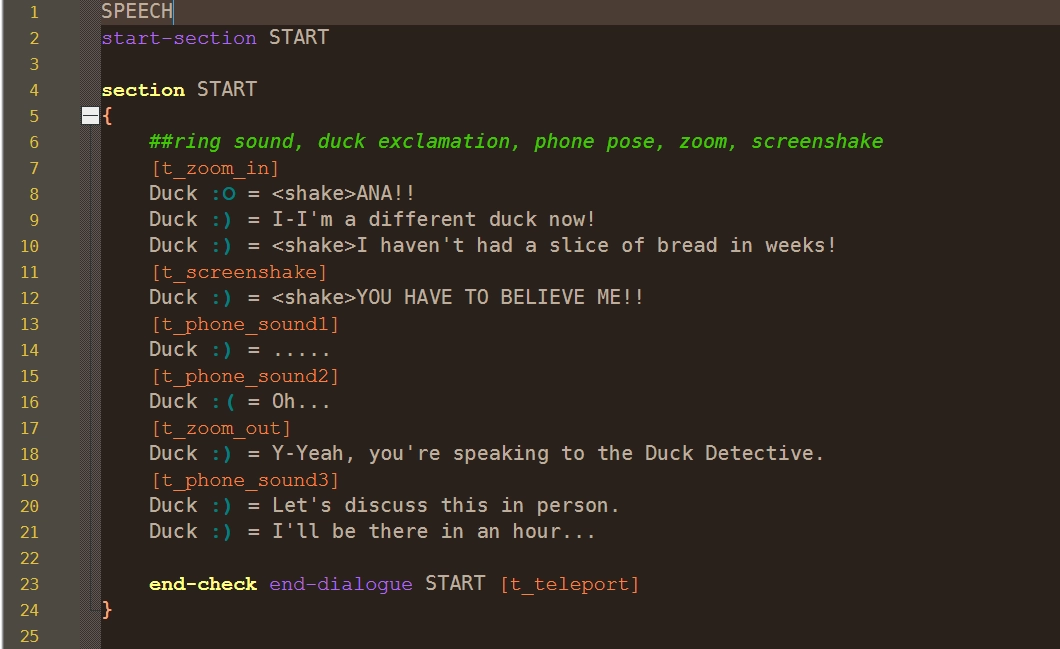
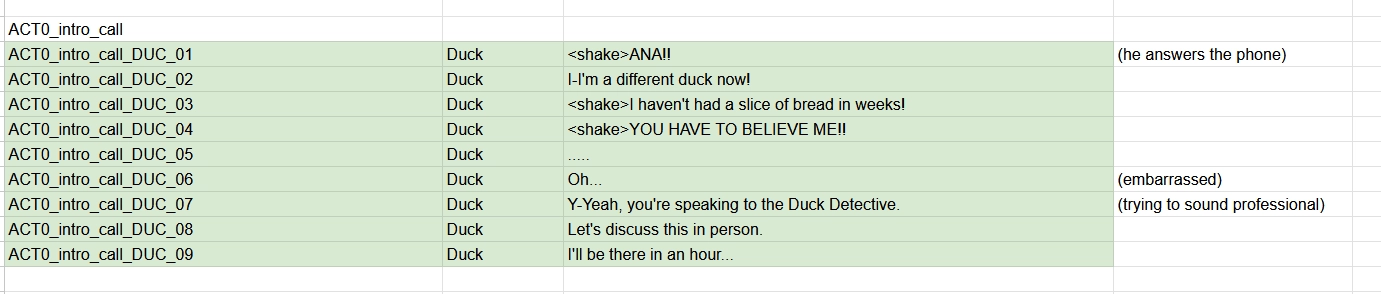
The tool we have for exporting dialogue for voice acting scripts can remove these tags and other data so it’s easy for them to read while they’re performing. Some are left though if they help articulate the intended emotion.
Febucci: During development, was there any feature you wished Text Animator had?
Joni:
There’s nothing I can think of off the top of my head. It is really nice that Text Animator came with a typewriter out of the box for dialogue printing. Having all the default preset animations is also really useful to quickly get to grips with what’s available. I often prefer a plugin/tool which does one thing really well, rather than being a general toolkit solution.
Playtesting, puzzles, and design
Febucci: What is something on the design side that you didn’t know before, but came to understand through the development of these two games?
Joni:
I’m someone who wants to do everything, all the time, all at once. But (I think) I’ve finally learnt that it’s unhealthy and to slow down a bit.
I think game design is a huge space to explore, so it’s wise to focus on one niche for commercial work. I guess it’s a lot like food in a way. I like to eat all kinds of food, but if I were to set up a restaurant it would be important to create a menu around one cuisine. Maybe it’s common sense but it took me some time to understand properly.
As a team, we’ve specialised in making these short, linear, narrative experiences. And it excites me to push the boundaries of this domain. How can we make the coolest, most impactful interactive stories that will inspire others? I am very lucky to get to work with such talented people on such a rewarding challenge.
F: And from a technical standpoint, what was one challenge you underestimated and would approach differently today?
Joni:
I underestimated the long-term support requirements for games in a digital age. Even for a linear singleplayer title, bugs can crop up from time to time. With each additional title, more time can get eaten up supporting previous titles.
Take for example, when Unity had a security vulnerability in September 2025. Dusting off 5+ year old projects to update across various platforms was painstaking work that cut into deadlines that had already been charted for Apple Crumble’s development.
It’s important for me to have a set amount of time per week/month allocated for game support. It ensures I don’t spend too long on the old and then I get to spend time creating new things!
Organizing a small team
Febucci: Looking back at the last few years, what is one lesson you learned about running an indie studio that you wish you had known earlier?
Joni:
There are two main things I can think of off the top of my head that were important lessons:
Hierarchy is an important part of communication. I think sometimes I had this notion that big decisions needed to be made collaboratively, but it can be detrimental to progress to have conflicting opinions trying to steer the ship. There’s less time wasted when the authority for each discipline is clear to everyone.
Secondly, running a studio is not the same job as getting to make games for a living. There’s a lot of administration and operations tasks that are just generally a part of running any business, gamedev or not.
I’m not necessarily sure there’s anything I would like to have known earlier though. Some of the most useful knowledge in life can’t be understood without the experience to back it up. Maybe a little too philosophical though!
Febucci: If you had to leave one practical piece of advice for a small team that wants to make a short, polished, and sustainable narrative game, what would it be?
Joni:
Only one, that’s difficult!
I really like John Thyer’s blog post about this topic: https://farawaytimes.blogspot.com/2023/02/how-to-make-good-small-games.html
I really like his idea of games making promises, it’s an elegant analogy.
So I guess my one (cheeky) piece of practical advice is to read his blog post.
Thanks
That's a wrap! Huge thanks to Joni for taking the time to chat with us and we wish to Happy Broccoli Games all the best for Apple Crumble! We hope you enjoyed this interview and learned something new.
See you in the next post!
Ciao 🫶🏼

Junior producer and social media manager of Febucci Team. Graduated as an engineer and familiar with many areas of video game development. Also founded and managed the first student video game development team in Italy with Daniel.

Sincere posts about game development
We have been making games for more than 10 years and we want to share with you everything we have learned along this journey, from game engine tutorials to the way we see things in general, including heartfelt rants and exciting wins. If you find what we do valuable, please consider joining the newsletter!
- Exclusive insights sent via email only
- Read extra content when logged in
- Join a friendly and sincere community
- Help us stay independent from algorithms
More Posts


Comments